Last Updated: November 11, 2026
Quick Summary
Signs your tree needs professional pruning include dead branches that show no green growth, dry brittle bark, and no spring buds, along with crossing branches that rub and wound the bark. Large cracks, mushrooms at the base, sudden leaning, heavy dieback, or limbs on a roof or in wires also call for a certified arborist.
- Dead twigs crack dry when snapped, while live twigs bend first.
- Mushrooms or conks on the trunk or roots mean internal decay.
- Crossing branches rub together and wound bark, letting in decay and pests.
- A wrong cut tears bark, leaves a rotting stub, or removes the branch collar.
- Any branch near a power line is a job for the utility company, never a homeowner.
Table of Contents
- How to Spot Dead Branches on a Tree
- Why Crossing Branches on Trees Need a Certified Arborist
- When Tree Branches Near a House Become a Hazard
- Frequently Asked Questions
How to Spot Dead Branches on a Tree
Dead branches show no green growth, dry brittle bark, and no spring buds. Spotting them early helps you judge when a tree needs professional pruning, and most homeowners can check from the ground.
- Bare limbs in summer. No leaves while the rest is green means dead or dying.
- Scratch the bark. Green underneath is living; brown and dry is dead.
- Snap a twig. Dead twigs crack dry; live ones bend first.
- Check for fungus. Mushrooms or conks on trunk or roots mean internal decay.
- Watch for dieback. Large bare sections of crown signal a sick tree.
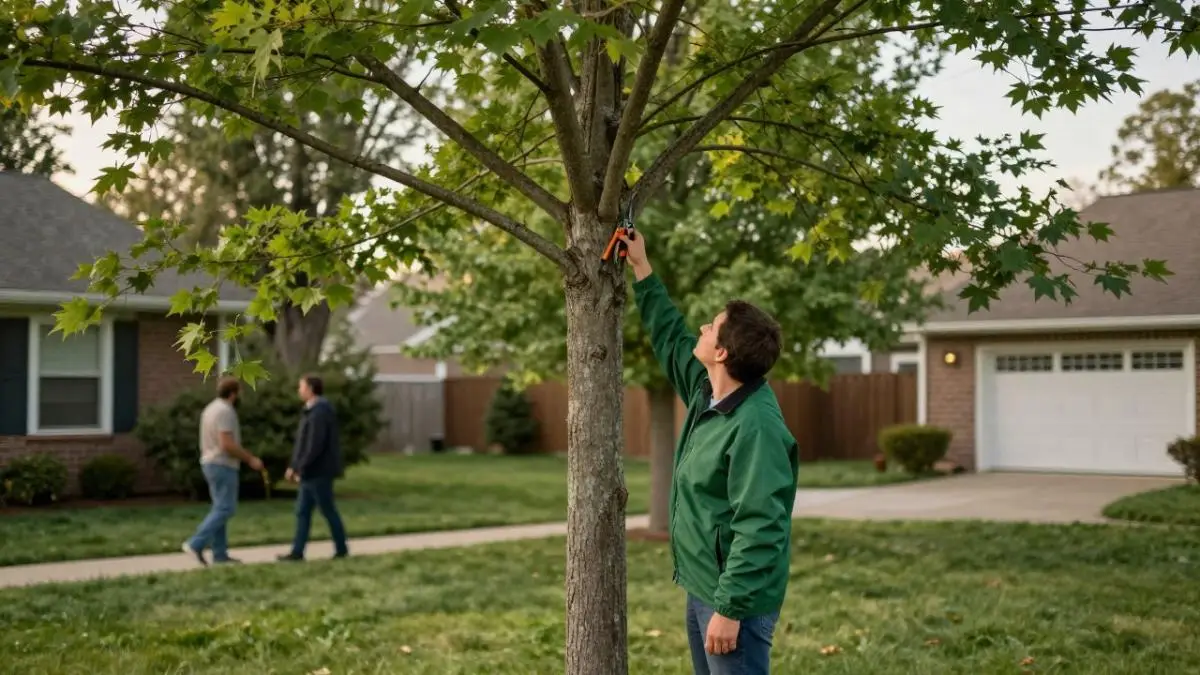
Dead limbs overhead can drop without warning, so do not stand under them. If you find more than a few, learn how proper pruning restores tree health before cutting.
Here are the ground-level checks the article lists for spotting dead branches early.
| Sign | What to look for |
|---|---|
| Bare limbs in summer | No leaves while the rest is green |
| Scratch the bark | Green underneath is living; brown and dry is dead |
| Snap a twig | Dead twigs crack dry; live ones bend first |
| Fungus | Mushrooms or conks on trunk or roots mean internal decay |
| Dieback | Large bare sections of crown signal a sick tree |
Why Crossing Branches on Trees Need a Certified Arborist
Crossing branches rub together and wound the bark, letting in decay and pests that weaken the structure. Fixing them takes more than a quick trim, which is why a qualified arborist should assess the problem.
An arborist examines the branch union where limbs meet the trunk; crowded or rubbing limbs there need selective pruning, not a blunt chop. A wrong cut tears bark, leaves a rotting stub, or removes the branch collar the tree needs to heal.
Our guide on the 5 key differences between an ISA Certified Arborist and a tree trimmer explains each role. For Bothell homeowners, professional tree pruning services from a certified crew are the safest route.
When Tree Branches Near a House Become a Hazard
Branches near a house turn dangerous when they touch the roof, hang over a walkway, or lean toward power lines. A limb scraping shingles can tear off flashing, and any branch near a power line is a job for the utility company, never a homeowner with a saw.
- Large cracks or splits in the trunk
- Mushrooms at the base
- A tree that has suddenly started to lean
- Heavy dieback across the crown
- Limbs on a roof or tangled in wires
These signs of structural weakness will not be fixed by routine trimming. Our guide on how to identify hazardous trees on your property walks through each one, and a tree risk assessment gives a clear answer on safety.
A leaning tree or a cracked trunk is not a wait-and-see problem. Elite Tree Care serves Bothell and the surrounding Snohomish and King County area with ISA Certified Arborists on staff, 24-hour emergency tree service, and full tree, shrub, and hedge maintenance. Get started with Elite Tree Care and keep your property safe and your trees healthy.
Frequently Asked Questions
How often should trees be pruned in Bothell, WA?
Most mature trees in the Bothell area do well with professional pruning every two to three years, though fast-growing species and trees near structures may need annual attention. Dead, broken, or hazardous limbs should be addressed as soon as you notice them rather than waiting for a scheduled cycle. An ISA Certified Arborist can assess your trees and recommend a schedule based on species, age, and proximity to your home or power lines.
Can overgrown branches damage a house or power lines?
Yes. Branches that touch a roof, siding, or power lines can cause real damage during windstorms, and limbs that rub against shingles or gutters wear down surfaces over time. Any branch within reach of a power line is a serious safety risk and should be handled only by a qualified professional, never by a homeowner. Keep tree branches near a house trimmed back for roof clearance and call a certified arborist when growth gets close to utility lines.
When should you call an ISA Certified Arborist to inspect a tree?
Call an arborist when you see dead branches on a tree, crossing branches on trees, cracks or splits in the trunk, mushrooms at the base, sudden leaning, or heavy dieback. These signs can point to structural weakness or decay that routine trimming will not fix. A certified arborist evaluates tree health, branch unions, and clearance issues, then recommends selective pruning or another treatment. Tree pruning safety is another reason to call: climbing and chainsaw work near structures or power lines is not a DIY job.
