Last Updated: November 12, 2026
Quick Summary
Preventing storm damage to trees starts with inspecting your property before storm season for trunk cracks, mushrooms at the base, crossing branches, and leaning trees with exposed roots. Prune weak, crossing, and dead branches in late winter so wind passes through the crown instead of catching it, and book a hazardous tree assessment with an ISA Certified Arborist before the first big blow.
- Storm damage rarely comes from one cause; wind damage to urban trees reflects a mix of biological, structural, and environmental factors.
- Saturated soil plus shallow roots is the setup we see most after a Puget Sound windstorm.
- Pruning is the highest-value prevention step: structural pruning removes weak, crossing, and dead branches.
- Topping a tree to reduce wind catch does the opposite, forcing weak regrowth that snaps more easily.
- A Florida International University Wall of Wind study found trees reduced wind force on some building segments by as much as 50%.
Table of Contents
- Step 1: Inspect Trees for Structural Weakness Before Storm Season
- Step 2: Prune for Tree Structure and Wind Resistance
- Step 3: Book a Hazardous Tree Assessment in Bothell Before the First Big Blow
- Frequently Asked Questions
Step 1: Inspect Trees for Structural Weakness Before Storm Season
Preventing storm damage to trees starts with a slow walk around your property before the first big blow. Look for trunk cracks, mushrooms at the base, crossing branches, and leaning trees with exposed roots or bark trapped in a fork, weak unions that split under wind load.
Storm damage rarely comes from one cause. A 2025 study found wind damage to urban trees was determined by a mix of biological, structural, and environmental factors (study on storm-induced tree damage). In Bothell, heavy rain softens the ground long before the wind arrives, so saturated soil plus shallow roots is the setup we see most after a Puget Sound windstorm.
Our guide on identifying trees that could cause problems during storm season covers the warning signs, and this piece on how to identify hazardous trees on your property explains what to do next.
Step 2: Prune for Tree Structure and Wind Resistance
Pruning is the highest-value prevention step: structural pruning removes weak, crossing, and dead branches so wind passes through the crown instead of catching it.
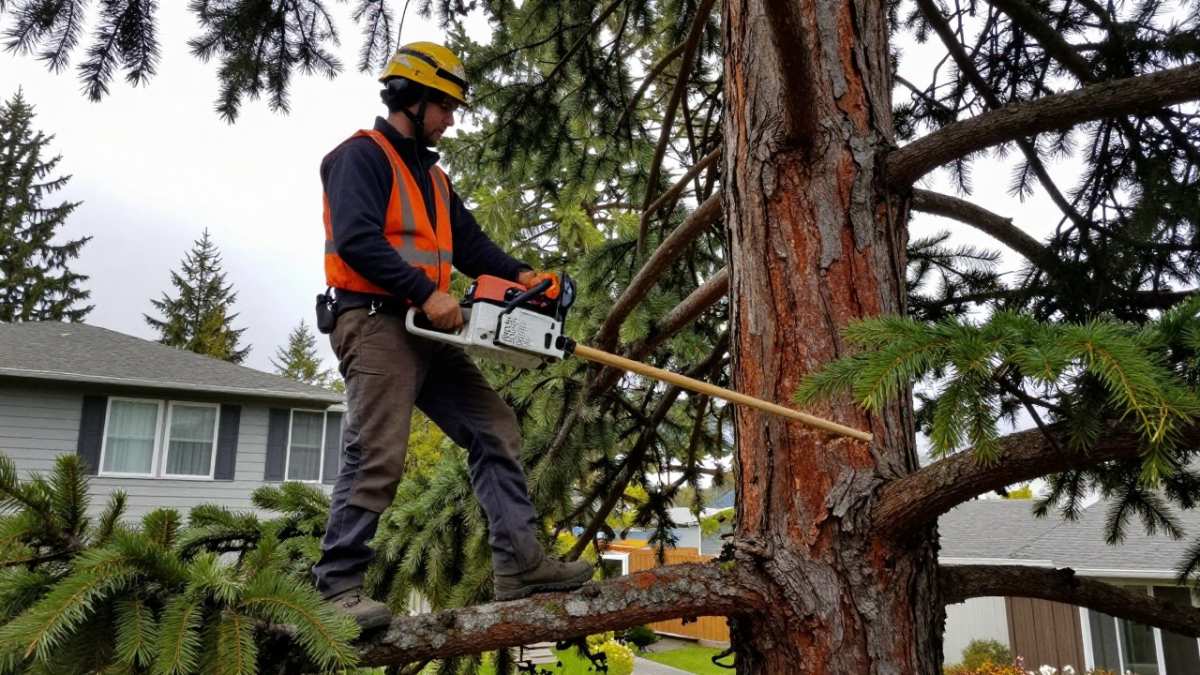
Prune in late winter while trees are dormant, and avoid heavy cuts right before a storm. A clean cut heals better than a torn stub, which is why structural pruning is a job for someone who climbs and ropes safely. Our tree pruning services are available across Snohomish and King County, and this explainer on how pruning creates a healthier tree shows why the right cuts matter.
Watch out: topping a tree to reduce wind catch does the opposite, forcing weak regrowth that snaps more easily in the next storm.
Step 3: Book a Hazardous Tree Assessment in Bothell Before the First Big Blow
A hazardous tree assessment is a professional inspection that rates the risk each tree poses to people and property. An ISA Certified Arborist checks structure, roots, soil, and targets, then tells you what to prune, monitor, or remove.
Trees can also help. A Florida International University Wall of Wind study found that trees around a low-rise building reduced wind force on some building segments by as much as 50% (FIU Wall of Wind tree study). The catch: that protection only holds when the trees themselves are sound.
At Elite Tree Care, our ISA Certified Arborists handle assessments across Bothell and the surrounding Snohomish and King County area. You can book a tree risk assessment before the first big blow rather than after.
Watch out: if a tree is already resting on power lines or leaning hard toward a structure, do not touch it. Call your utility or emergency services first, then an arborist.
Your Pre-Storm Checklist
| Task | When | Who |
|---|---|---|
| Walk the property for defects | Early fall | You |
| Remove dead or crossing branches | Late winter | Arborist |
| Full risk assessment | Before storm season | ISA Certified Arborist |
Bothell storms do not wait for a convenient weekend, and the trees closest to your house are the ones that matter most. Elite Tree Care sends ISA Certified Arborists to assess hazards, prune for structure, and handle removals when a tree cannot be saved, with 24-hour emergency service across Snohomish and King County. Get a free estimate and protect your property before the wind picks up.
Frequently Asked Questions
How can I protect my trees from high winds in the Pacific Northwest?
Start with structural pruning while trees are young, then keep up routine inspections as they mature. Healthy, well-placed trees can reduce wind loading on a building, so they are worth protecting. Remove dead or broken branches, watch for codominant stems and weak branch unions, and have an ISA Certified Arborist check anything you are unsure about before storm season.
Does homeowners insurance cover tree damage from a storm?
Coverage usually depends on what fell and where. If a storm knocks your tree onto your house or a neighbor’s structure, many policies cover the damage to the structure, though the tree removal itself may only be covered up to a limit. If a tree was already dead or known to be hazardous, insurers may push back. Keep dated photos and inspection records so you can document tree health before the storm, and confirm the specifics with your insurer.
What are the signs of a hazardous tree that needs professional inspection?
Look for codominant stems with a tight V-shaped union, cracks or seams along the trunk, mushrooms or decayed wood at the base, dead branches in the crown, and roots that are lifting soil or exposed on one side. Storm-related tree failure usually reflects several interacting factors, so no single sign tells the whole story. If you spot several, book a hazardous tree assessment before the next windstorm.
