
Last Updated: November 7, 2026
Quick Summary
Storm damage tree removal in the Bothell area starts with one rule: do not touch anything under a power line. The first hour is about safety and documentation, not cleanup, so get everyone inside, look up for hanging limbs and split trunks, and photograph everything before moving a single branch. Call a professional for anything larger than a fallen shrub.
- Call your utility provider if a line is down and never assume a downed line is dead.
- A tree is dangerous when it shows structural failure plus a target it could hit.
- Call for same-day help when a tree leans over a bedroom, driveway, or play area.
- A Level 2 ground-level inspection is what most storm-damaged residential trees need.
- Keep people and vehicles outside the drip line of any damaged tree.
Table of Contents
- What to Do First After a Storm Damages a Tree
- How to Tell If a Storm-Damaged Tree Is Dangerous
- When a Hazardous Tree Assessment Becomes Urgent
- What a Tree Risk Assessment Covers and Why It Matters
- Emergency Tree Removal in King County: When Waiting Costs More
- Winter Storm Tree Damage: A Seasonal Inspection Calendar
- How to Verify an Assessor Before You Hire
- Getting a Free Estimate for Storm-Damaged Trees
- Frequently Asked Questions
What to Do First After a Storm Damages a Tree
Storm damage tree removal in the Bothell area starts with one rule: do not touch anything under a power line. The first hour of storm damage tree removal is about safety and documentation, not cleanup.
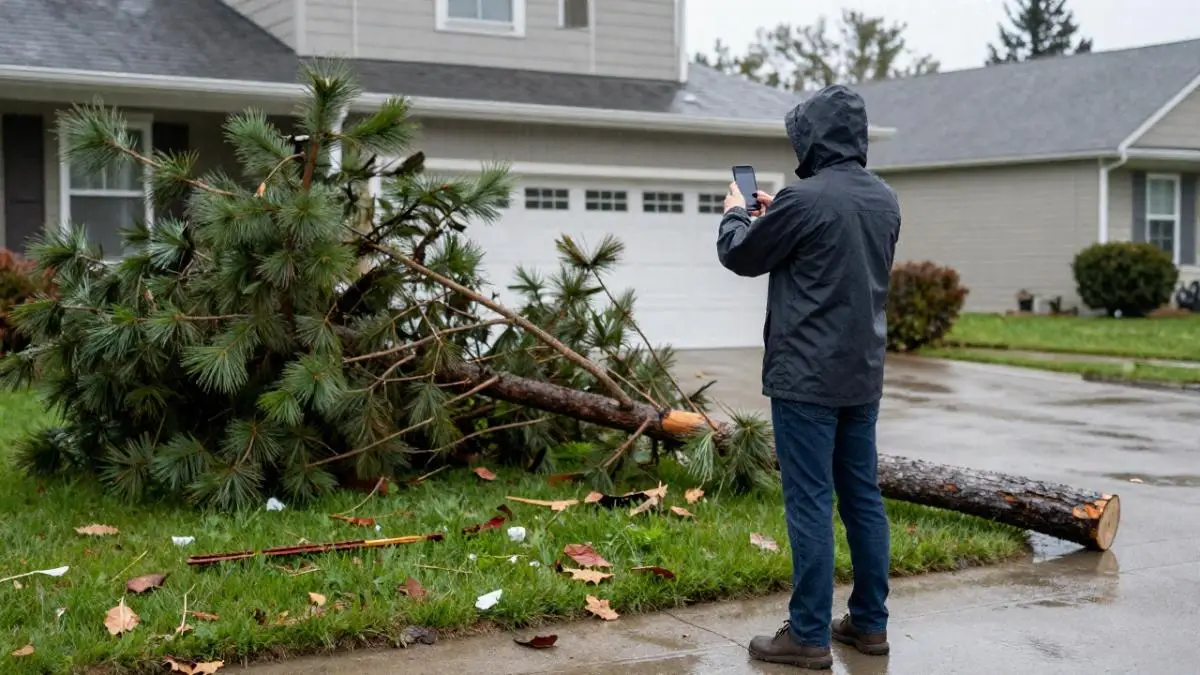
Here is the order we recommend:
- Get everyone inside and account for pets. Stay out of the yard until you can see the full extent of the damage.
- Look up before you look down. Check for hanging limbs, split trunks, and anything leaning toward the house.
- Call your utility provider if a line is down. Never assume a downed line is dead.
- Photograph everything before moving a single branch. Wide shots, close-ups, and the tree’s position relative to structures.
- Keep people and vehicles clear of the drip line. A damaged tree can drop without warning.
- Call a professional for anything larger than a fallen shrub. A tree under tension can kick back and strike whoever cuts it.
For a fuller walkthrough of the first 24 hours, see our guide to dealing with storm damage to trees in Bothell and Kirkland.
Watch out: Never walk under a leaning tree to get a better photo. Storm-damaged trees can fail hours or days after the wind stops, and the root plate may be weaker than it looks.
How to Tell If a Storm-Damaged Tree Is Dangerous
A storm-damaged tree is dangerous when it shows structural failure plus a target it could hit. One without the other is a lower priority, and treating every damaged tree the same wastes money.
Walk the property and look for these signs:
- Root plate lifting. Soil cracked or mounded on one side of the trunk means the roots have started to pull free.
- Trunk cracks or splits. A vertical crack in the main stem is a serious structural weakness.
- Hanging limbs. A broken branch caught in the canopy can fall at any time, often without wind.
- A new lean. Compare against older photos; a fresh lean of any amount is a red flag.
- Cavities and decay. Soft wood, fungal growth, or hollow spots near the base.
- Dead branches in the upper canopy. These come down first in the next storm.
A tree within reach of a house, driveway, fence, or sidewalk that shows any sign above warrants a professional look. If it fell in an open part of the yard with nothing to hit, it can usually wait for a scheduled visit. See our guide on identifying trees that could cause problems during storm season.
When a Hazardous Tree Assessment Becomes Urgent
A hazardous tree assessment becomes urgent when a tree has a visible defect and something valuable within falling distance, especially if that area is occupied regularly. In practice, that means today, not next week.
Call for same-day help when:
- A tree is leaning over a bedroom, driveway, or play area
- You can see cracked soil or a lifted root plate
- A large limb is hanging and has not fallen
- The tree is touching or near a utility line
- Wind is still forecast and the tree is already compromised
A tree that dropped a limb in an open corner of the yard, with nothing beneath it and no further wind coming, can wait for a normal appointment. The difference comes down to two questions: how likely is failure, and what happens if it fails?
What a Tree Risk Assessment Covers and Why It Matters
A tree risk assessment is a structured inspection that estimates how likely a tree is to fail, what the consequences would be, and what can reduce the risk (Quantified Tree Risk Assessment Used in the Management of Amenity Trees). It is not a quick look from the truck or a removal quote.
A proper assessment covers four things:
- Tree defects. Cracks, cavities, decay, included bark, old wound sites, and storm-created splits.
- Root and soil condition. Root damage, fungal brackets at the base, soil mounding, and cracked ground on the tension side of a lean.
- Canopy condition. Deadwood, unbalanced weight, hanging limbs, and broken tops.
- Targets. What the tree could hit and how often people, vehicles, or structures are actually there.
That last item is the one homeowners most often skip. A cracked hemlock at the back of an empty lot and the same hemlock leaning over a Bothell bedroom are the same tree with very different risk.
Assessment levels and what each includes
Tree risk work is commonly organized into three levels, and knowing them helps you understand what a report should contain.
|
Level |
What It Involves |
When It Fits |
|---|---|---|
|
Level 1 |
Limited visual assessment, often a walk-by or drive-by from the ground |
Routine annual review, screening many trees quickly |
|
Level 2 |
Ground-level visual inspection of the full tree, including root flare, trunk, and canopy |
After a storm, a new lean, or a visible change |
|
Level 3 |
Advanced or diagnostic assessment, possibly aerial, with tools such as a resistograph or sonic tomography |
Suspected internal decay, structural doubt, or a high-value target |
A Level 1 assessment is a screening tool that tells you which trees deserve a closer look. A Level 2 assessment is what most storm-damaged residential trees need: a trained arborist walks the tree, checks the root flare and soil, looks for cracks and included bark, and evaluates the target. A Level 3 assessment is reserved for high-stakes cases where the answer is not visible from the ground, such as a mature tree near a house with a cavity suggesting internal decay.
When an advanced or diagnostic assessment is needed
A Level 3 assessment is usually warranted when a Level 2 inspection finds something that cannot be resolved from the ground, when the target is occupied daily, or when the cost of being wrong is high. Common triggers include:
- A cavity or fungal conk on the trunk of a tree within falling distance of a house
- A history of failure in the same species or the same stand
- A tree that has already lost a major limb and shows additional defects
- A property dispute, insurance claim, or HOA question that needs a documented opinion
What a professional arborist evaluates
Findings should be put in writing so you have a record for your insurer, HOA, or a future buyer. To get a documented evaluation of a specific tree, request a tree risk assessment.
Watch out: A verbal “it looks fine” is not an assessment. If you need documentation for an insurer or a buyer, ask for the written report before the arborist leaves the property.
Emergency Tree Removal in King County: When Waiting Costs More
Emergency tree removal in King County is warranted when a damaged tree blocks access, threatens a structure, or sits on a utility line. Waiting rarely saves money.
The math is straightforward. A tree on the ground in an open yard is a cleanup job.
We run 24-hour emergency tree service for exactly this reason. Storms do not check the clock, and a tree that shifts at 2 a.m. needs someone who will answer.
Watch out: Do not let anyone without verifiable insurance touch a storm-damaged tree on your property.
Winter Storm Tree Damage: A Seasonal Inspection Calendar
Winter storm tree damage in King County follows a predictable rhythm, and a simple calendar catches most of it before the wind does. The first soaking rains of late fall saturate the soil, then a southwest windstorm pushes through the Puget Sound lowlands. Saturated soil plus wind uproots shallow-rooted trees, which is why late fall is the window to act rather than the week after the storm.
A practical routine for a King County property looks like this:
|
Season |
What to Check |
Why It Matters |
|---|---|---|
|
Early fall |
Deadwood, hanging limbs, canopy balance |
Remove weak wood before the wind arrives |
|
Late fall |
Root plates, soil mounding, new leans |
Saturated soil is when shallow-rooted trees fail |
|
Winter, after each storm |
Broken limbs, cracks, debris piles, new lean |
Post-storm damage compounds with the next system |
|
Late winter |
Trunk cracks, cavities, fungal growth |
Decay and conks show up after wet months |
|
Spring |
Overall canopy condition and new growth |
Confirms what survived the season |
|
Summer |
Drought stress and dead branches |
Dry trees drop limbs too |
Most trees need a full inspection once a year. Mature trees near a house or in a high-traffic area deserve a closer look every one to two years. Anything that took storm damage gets reassessed right away.
The post-storm routine
After a wind event, walk the property in daylight and in this order:
- Look up and stay back. Check for hanging limbs and split trunks before you walk under anything.
- Check the root flare. Cracked or mounded soil on one side of the trunk means the root plate has moved.
- Compare the lean. Use an older photo or a fixed landmark to judge whether the tree has shifted.
- Photograph before you touch anything. Wide shots, close-ups, and the tree’s position relative to structures.
- Sort urgent from scheduled. A tree leaning over a bedroom, driveway, or play area is a today call; a limb down in an open corner can wait.
Urgent warning signs and what to do next
Some post-storm signs mean keep people away and call a professional now, not next week:
- A tree leaning toward a house, driveway, or play area
- Cracked soil or a lifted root plate
- A large limb hanging and not yet fallen
- A tree touching or near a utility line
- A split trunk or a vertical crack in the main stem
If any of those are present, keep people and vehicles outside the drip line and call a qualified arborist. Do not try to cut a limb under tension yourself, a storm-damaged tree can kick back and strike whoever cuts it. If a line is down, call Puget Sound Energy and never assume a downed line is dead.
Documentation and follow-up
Keep a simple record for each tree: the inspection date, the arborist’s name and credentials, defects observed, the recommendation, and any change after a weather event. That record is useful for an insurer, an HOA, or a future buyer, and it makes the next assessment faster.
Watch out: Do not assume a tree that survived one storm is safe for the next. A tree that lost a major limb has a changed load pattern, and the next wind event can finish what the first one started.
How to Verify an Assessor Before You Hire
Verifying an assessor takes three checks, and any legitimate company will help you complete all three without hesitation. Ask before you book, not after the crew arrives.
- Credentials. Ask whether the arborist holds ISA Certified Arborist status, and get the name of the person who will actually assess the tree.
- Insurance. Request a certificate of insurance showing general liability coverage, and confirm the crew on site is covered.
- Crew structure. Ask directly whether the climbing work is done in-house or subcontracted.
- Written scope. Get the work described in writing, including what happens to the debris and the stump.
- References. Ask for recent storm cleanup work in your area.
A company that dodges any of these questions is telling you something. We are happy to answer all five on the phone before you commit to anything.
Getting a Free Estimate for Storm-Damaged Trees
Getting a free estimate starts with photos and a phone call, and the visit itself should cost you nothing.
What drives the number up or down:
- Size and species of the tree
- Proximity to the house, fence, or power lines
- Access for trucks and equipment
- Whether the tree is still standing or already down
- Debris haul-away and stump grinding
If you are ready for a real number, request a free estimate and we will schedule a visit. For urgent situations, call us directly and we will tell you what we can do today.
The gap between a manageable cleanup and a repair bill is usually a single phone call made early.
Elite Tree Care serves homeowners and property managers across Bothell and the surrounding King and Snohomish County area. Our team includes ISA Certified Arborists, and we offer 24-hour emergency tree service.
Frequently Asked Questions
How much does a tree risk assessment cost?
Pricing for a tree risk assessment depends on the number of trees, their size, access, and whether a basic visual walk-through or an advanced diagnostic assessment is needed. Request a free estimate from Elite Tree Care for a quote specific to your property.
What should I do first if a storm damages a tree on my property in King County?
Keep people and vehicles clear of the tree, and do not touch anything in contact with a power line; call the utility instead. Photograph the damage from a safe distance for your insurer. Then call a company with ISA Certified Arborists to assess whether the tree can be saved or needs storm damage tree removal. Avoid cutting limbs yourself, since tension in storm-split wood can cause sudden, dangerous movement.
How soon should a leaning tree be inspected after a winter storm?
A new lean after a storm signals possible root damage or a structural failure, so have it inspected as soon as possible rather than waiting for the next season. A tree that was already leaning slightly and has not moved is a different case and can be scheduled routinely. An arborist can compare the lean, check the soil at the base for heaving, and rate the likelihood of failure against nearby targets.
Can a tree with a split trunk survive after a storm?
Sometimes, but it depends on where the split sits and how much sound wood remains. A shallow fork crack high in the canopy may be cable-braced and monitored, while a split running into the main trunk usually means removal. Only a qualified arborist can judge this on site. Ask for a written assessment report so you have a record of the recommendation and any follow-up inspection date.
