
Last Updated: November 6, 2026
Quick Summary
Get a tree risk assessment when a tree has a defect, a target in its fall zone, and enough size to matter, or when something has changed around it. Immediate warning signs include a new lean, trunk cracks, root-plate soil heaving, or mushrooms at the root flare. A low-risk rating only covers the stated assessment timeframe, usually one year.
- Healthy trees benefit from a yearly visual check and a fuller inspection every few years.
- Trees with known defects or past structural pruning need reassessment every one to two years.
- After a storm, keep people away and call an arborist the same day for a new lean or lifted root plate.
- A Level 2 assessment is a detailed ground-level inspection scoring each tree individually.
- Ask for the ISA certification number and verify it in the ISA’s public directory.
Table of Contents
- What a Tree Risk Assessment Actually Answers
- Tree Hazard Signs That Mean Call Now, Not Later
- How Often to Assess Trees on Your Property
- When to Schedule a Tree Assessment After a Storm
- What a Level 2 Tree Risk Assessment Involves
- How to Choose and Verify a Qualified Arborist
- Book Your Assessment Before the Next Windstorm
- Frequently Asked Questions
What a Tree Risk Assessment Actually Answers
A tree risk assessment is a structured inspection that estimates how likely a tree is to fail, what it could hit if it does, and how serious the outcome would be (Risk Assessment and Risk Perception of Trees). The first thing a good arborist will tell homeowners is what the report cannot do: it cannot promise a tree will never fall.
That distinction matters more than most people expect. According to EXTERNAL_LINK: Virginia Tech Community Forestry’s urban forester column on tree risk | pubs.ext.vt.edu, the chance of failure reaches 100% over a long enough timeframe, which is why assessors work from a stated assessment timeframe, usually one year. A “low risk” label means low risk within that window, not forever.
So when should you get a tree risk assessment? The short answer: when a tree has a defect, a target, and enough size to matter, or when something has changed around it. The assessment answers three questions:
- Likelihood of failure: does the tree have a structural weakness that could give way?
- Likelihood of impact: if it fails, is there a target in the fall zone, such as a house, driveway, fence, or patio?
- Consequences: how bad would the damage or injury be?
Our arborists walk the property, rate each tree, and hand you a written assessment report you can act on. You can see what that tree risk assessment covers before you book.
Tree Hazard Signs That Mean Call Now, Not Later
Some defects can wait for a scheduled visit. Others mean you should keep people and cars away from the tree today and call a qualified arborist. Watch for these tree hazard signs:
- A new lean that appeared after a storm, especially with soil heaving at the base
- Cracks or splits in the trunk, or two trunks pushing apart at a fork
- Mushrooms or conks growing on the trunk or root flare, a sign of decay
- Cavities, soft wood, or hollow sound when the trunk is tapped
- Dead branches or hanging limbs caught in the canopy
- Root damage from digging, paving, or grade changes near the tree
- Bare, thinning canopy on one side while the rest looks healthy
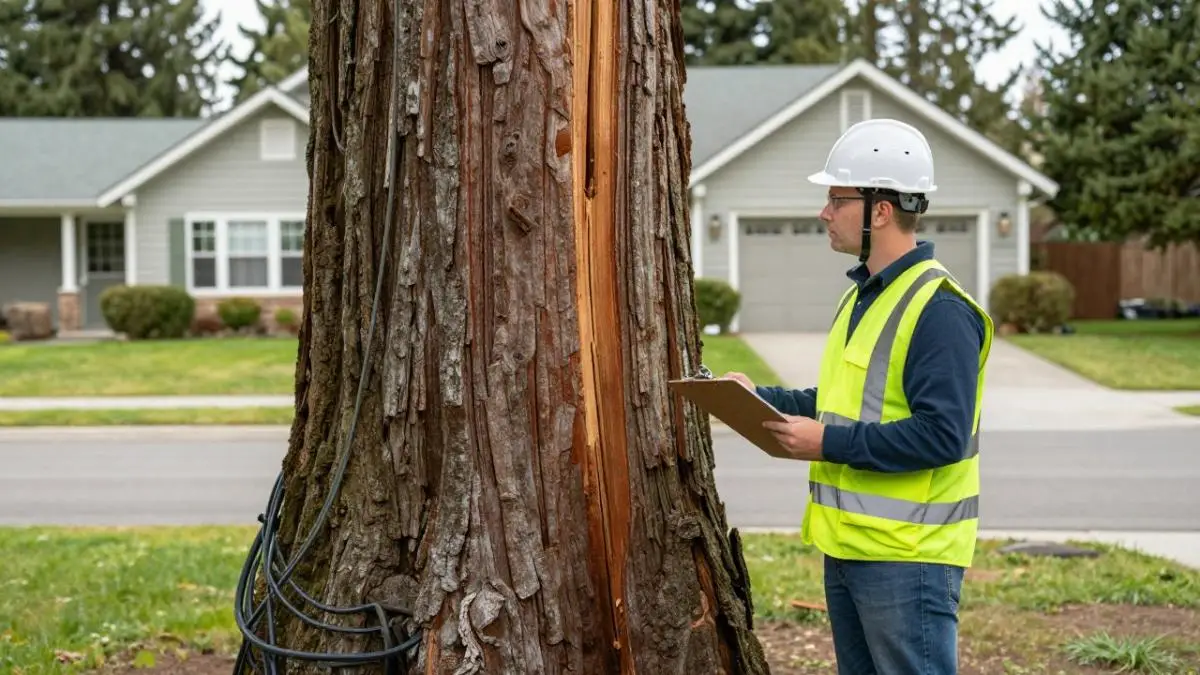
A common mistake is waiting for a limb to drop before calling. By then the tree has already told you something. For a deeper walkthrough of spotting trouble on your own land, read our guide on how to identify hazardous trees on your property.
Watch out: never try to remove a hanging limb or a leaning tree yourself. A limb under tension can kick back, and a cracked trunk can split without warning.
How Often to Assess Trees on Your Property
Many healthy trees benefit from a visual check once a year and a fuller inspection every few years. Trees near a house, driveway, or play area deserve the annual look. Older trees, trees with known defects, and trees that have already been pruned for structure need reassessment on a shorter cycle, often every one to two years.
Here is a simple calendar we give clients:
| Season | What to Check | Why It Matters |
|---|---|---|
| Late fall | Post-storm damage, dead limbs | Storms strip weak wood first |
| Winter | Bare-tree structure, cracks, forks | No leaves means defects show clearly |
| Early spring | Root flare, soil heaving, new lean | Wet soil loosens root plates |
| Summer | Canopy condition, dead branches | Drought stress shows up fast |
Inspection frequency is not a rule set in stone. It follows the tree. A mature Douglas fir leaning toward a bedroom window earns more attention than a young maple at the back of the lot.
When to Schedule a Tree Assessment After a Storm
Book a tree assessment after a storm if any tree on the property has a new lean, exposed roots, cracked bark, or a limb hanging over something you use. In western Washington, wind and saturated soil do most of the damage, and the trees that fail are often the ones that looked fine a week earlier.
Not every post-storm issue belongs on the same timeline. Sort what you see into two buckets before you call anyone.
Call today and keep people away, these are immediate hazards:
- A tree that has lifted soil at the root plate, creating a visible mound or crack in the ground
- A new lean toward a house, driveway, power drop, or play area
- A split trunk, a fork pushing apart, or a crack that runs more than a few inches
- A limb hung up in the canopy (a “widow-maker”) that could drop without warning
- Any tree that has shifted enough to pull its roots out of the ground on one side
For those, rope off the area, keep cars and people out of the fall zone, and call a qualified arborist the same day. Do not stand under the tree to photograph it, and do not try to pull a hanging limb down.
Schedule within the next few weeks, these can wait for a booked visit:
- Small dead branches in the canopy that dropped on their own
- Minor bark wounds or scrapes on the trunk
- A tree that lost foliage but shows no lean, crack, or root movement
- Surface roots exposed by runoff, with the trunk still upright
A useful post-storm sequence most homeowners skip: walk the property from the outside in. Start at the curb and look at the whole tree’s silhouette before you get close. A lean or a missing top is easier to see from 30 feet away than from directly underneath. Then check the root flare, then the trunk, then the canopy. Photograph anything that looks different from your last memory of the tree, and note the date, that record matters if you file an insurance claim or sell the property.
The EXTERNAL_LINK: ISA Tree Risk Assessment Qualification program | isa-arbor.com trains assessors to judge exactly these post-storm conditions, and the difference between a trained eye and a quick look is real. A EXTERNAL_LINK: 2025 case study in Natural Hazards on street-tree failure assessments | link.springer.com found that expert agronomists and non-expert gardeners reached different conclusions about which street trees were likely to fail. In plain terms: guessing is not the same as assessing.
Our storm-season guidance on identifying trees that could cause problems during storm season covers what to photograph and what to flag before the next system rolls in.
What a Level 2 Tree Risk Assessment Involves
A Level 2 tree risk assessment is a detailed visual inspection from the ground, tree by tree, with each one scored for likelihood of failure, likelihood of impact, and consequences. It goes further than a Level 1 walk-through, which is a quick drive-by style check of many trees at once.
Research from EXTERNAL_LINK: R. W. Klein and coauthors in Arboriculture & Urban Forestry | auf.isa-arbor.com shows that assessor training and methodology shape the conclusions reached (Evaluating the Reproducibility of Tree Risk Assessment Ratings Across Commonly Used…). Who does the assessment changes the answer.
How to Choose and Verify a Qualified Arborist
Hire an ISA Certified Arborist, confirm the certification is current, and ask whether the person who inspects your trees is the same one who does the climbing and cutting.
Here is the checklist we suggest:
- Ask for the ISA certification number and check it on the ISA directory
- Confirm the crew is insured, and ask for the certificate of insurance
- Ask if climbing work is subcontracted or done in-house
- Get the assessment scope in writing before work starts
- Ask what happens after the report: who does the mitigation work
How to verify the credential, step by step. Ask for the arborist’s name and ISA certification number, then look both up in the ISA’s public credential directory. Certification is renewed on a cycle, so confirm the listing is current rather than expired. If the person who answers the phone cannot give you a certification number, that is your answer. For a fuller explanation of what the credential means, read our homeowner’s guide to ISA Certified Arborists.
What a written assessment report should contain. A report you can actually use will state the assessment level performed, the date, the assessment timeframe (often one year), each tree’s location and species, the defects observed, the target in the fall zone, the risk rating, and the recommended mitigation with a priority. If a report is a single sentence on an invoice, it is not an assessment, it is a sales pitch. Ask for the report in writing before any mitigation work is scheduled, so the recommendation and the work are separate decisions.
Questions to ask before you book:
- What level of assessment will you perform, and why that level for my tree?
- Will you inspect from the ground only, or will climbing or aerial inspection be needed?
- What is the assessment timeframe on the report, and what does that mean for my decision?
- Who performs the mitigation work, and is that a separate quote?
- How do you handle a tree you rate as high risk, what are my options besides removal?
Documentation and follow-up. Keep a simple file for each significant tree: the assessment date, the assessor’s name and credential number, the report, photos of any defect, and the date and outcome of any work done. After a major windstorm or a change on the property, a new addition, a driveway, a grade change, a removed neighboring tree, add a note and consider a reassessment. That file is what an insurer, a buyer, or a future arborist will ask for, and it takes ten minutes to start.
Book Your Assessment Before the Next Windstorm
The best time to get a tree risk assessment is before the wind does the deciding for you. If you have a large tree near your house, a lean you cannot explain, or a limb you have been meaning to deal with since last winter, put it on the calendar now.
Elite Tree Care serves homeowners and property managers across the Snohomish and King County area. We offer 24-hour emergency tree service, ISA Certified Arborists on staff, and comprehensive tree, shrub, and hedge maintenance.
Frequently Asked Questions
How much does a tree risk assessment cost?
Pricing depends on the assessment level, the number of trees, site access, and whether a written report is needed. A basic visual walk-through costs less than an advanced assessment that involves resistograph testing or root excavation. Request a quote from Elite Tree Care on the website for current pricing, and ask what the quote covers: how many trees, what level of assessment, and whether the report is suitable for a permit, HOA board, or insurance claim.
How often should you have your trees assessed?
For most mature trees in Snohomish and King Counties, a Level 1 visual check once a year and a fuller Level 2 assessment every three to five years is reasonable. Increase the frequency for trees with known defects, trees within striking distance of a house or driveway, and any tree that has already lost large limbs. After a significant windstorm, inspect within days rather than waiting for the next scheduled visit.
Should I get a tree risk assessment after a storm?
Yes, if the storm dropped limbs, split a crotch, shifted the root plate, or left the canopy noticeably thinner on one side. Wind damage often shows up as root-plate lift or soil cracking at the base before the tree visibly leans. A post-storm assessment separates trees that need pruning or cabling from those that need removal, and it gives you documentation if a limb later damages a neighbor’s fence or vehicle.
Who is qualified to assess tree risk?
Look for an ISA Certified Arborist, and ideally one who holds the ISA Tree Risk Assessment Qualification (TRAQ). TRAQ training covers the likelihood of failure, likelihood of impact, and consequences of failure, which together produce a risk rating. Ask whether the arborist who inspects your tree is the one who signs the report, and confirm the company carries liability insurance. Elite Tree Care staffs ISA Certified Arborists.
Don’t wait for the next storm to test your trees. Request a free estimate from Elite Tree Care, and our ISA Certified Arborists will assess the risk, explain your options, and help you protect your property before the wind picks up.
